 happybride
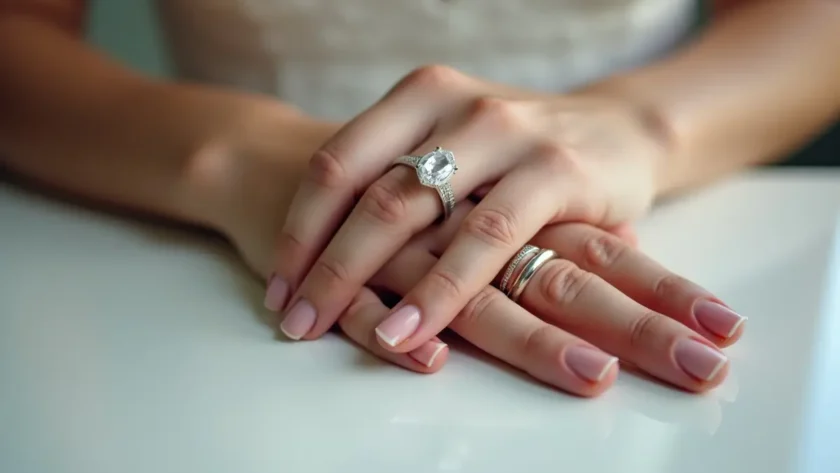
 Your engagement ring is the focal point of your bridal set. It also serves as the guide from which all other decisions cascade. The band style, the metal of the band, the setting and stone configuration, and even whether a ring can be resized in the years to come – all of this flows from the engagement ring you currently wear. Other shopping guides might portray all wedding bands as a lineup of equally viable choices.
But in reality, most of the decisions have already been crafted by the design of your engagement ring.
Read The Geometry Before You Shop
The most critical measurement is prong height – in other words, how high the center stone of your ring sits above your finger. You don’t need to measure this with a ruler. Just drag your thumbnail along the side of your ring and see if there’s space between the setting and the skin of your finger. If there is, your stone is high-set. If it’s almost or completely flush when you run your fingernail over it, it’s not.
High-set solitaires with prongs on a six-prong round shape ring, for instance, raise the stone significantly above the band, which leaves enough room for a flat, straight band that won’t gap against the diamond. Low-set or bezel-set rings cradle or tuck the stone and bring the metal very close to the skin. For those rings, you’ll need a contoured one instead. This high-set versus low-set measurement is where every other decision in this guide begins.
The Four Fit Categories, And Which One Your Ring Needs
Once you know your stone’s height, you can identify which of the four band profiles will actually work.
Flush Or Straight Band
This is the simplest option and the one most people picture. A flat band sits directly against the engagement ring with no modification. It works well when the center stone is raised high enough that the band doesn’t press into the setting. Round solitaires on classic four or six-prong settings are the most common candidate. If the band sits flush with no gap and no pressure point, you’re done with this decision.
Curved Or Contoured Band
A contoured band has a gentle arc built into its profile so it wraps around the engagement ring rather than pressing against it. This is the standard solution for halo settings, bezel-set stones, and any ring where the profile at the band’s junction isn’t flat. The curve isn’t decorative. It’s functional clearance. Getting the curve right matters – a band that’s too shallow will still press against the halo; one that’s too deep will create a visible gap that collects debris.
Chevron Or V-Shaped Band
A chevron band features a pointed notch at the peak to nestle long stone shapes: both pear and marquise cuts have a pointed end that a flat or gently curved band would rub against. The V-shape fits neatly around that point. If you’ve a marquise solitaire or a pear-cut stone and you’re wearing a flat band, what you are experiencing is either constant pressure on the tip of the stone or a gap. The chevron is here for a reason.
Notched Or Custom Band
Some engagement rings – heirlooms, designer settings with quirky proportions, anything with asymmetry – fit none of the above categories. A notch or curve can be modeled directly from your ring by a jeweler, using either traditional goldsmithing or CAD. This isn’t a weird or fancy option. Any ring that doesn’t fit the regular geometry, a bespoke band is often your only option for a clean fit that doesn’t begin to create wear points.
Metal Matching: Safe Choices And Deliberate Contrasts
The most compatible metal pairing is the same metal and finish as your engagement ring. Same karat, same color, same surface treatment. The rings will age at the same rate, and there’s no visual tension to manage.
That said, mixing metals is a valid design choice, not a mistake – provided it’s intentional. Yellow gold stacked against white gold or rose gold reads as intentional contrast if it’s clean and consistent. It reads as a mistake if the tones are close but not quite matching. If you’re mixing metals, make the contrast clear.
What you can’t ignore is hardness. Different metals wear at different rates, and when two rings rub together every day, the softer one loses material first. Platinum is harder than gold. An 18k gold band worn against a platinum engagement ring will show wear on the gold before the platinum shows anything. This isn’t a reason to avoid the combination, but it’s a reason to budget for periodic refinishing of the softer piece and to factor that into your long-term cost.
White gold has a specific maintenance problem worth mentioning. The bright white finish on white gold comes from rhodium plating – a thin coating applied over the gold alloy beneath. That coating wears off with daily wear, typically within 6 to 12 months (GIA). When it does, the warmer yellow or grey tone of the underlying gold alloy shows through. A white gold engagement ring already means you’re on a re-plating schedule. If you pair it with a platinum band, you’ll need to decide whether you want the two rings to match after the plating wears – platinum doesn’t change color – or whether you’re comfortable with the eventual contrast.
Finding The Right Fit: Where To Look
Once you know the band profile and metal you need, then you need to find rings that fit those constraints, rather than choosing based on pictures. For anyone in Western Australia, shopping wedding rings perth with your existing engagement ring in tow gives you the kind of in-person assessment where a jeweler can check prong clearance, identify wear points, and guarantee the fit before you commit to a new piece.
This in-person step isn’t optional. It’s the only reliable way to catch problems. A photo or an online listing can’t tell you whether a “curved” band actually matches the specific curve of your setting, or whether a chevron notch is deep enough for your particular stone. Bring both rings, try them together, and don’t sign off on a purchase until you’ve seen and felt how they sit side by side.
Stone Configuration And The Resizing Problem
Plain bands and half-eternity bands can both be resized by a jeweler. A full eternity band – stones set around the entire circumference – generally can’t be resized without removing and resetting stones. This matters more than most buyers expect.
Finger size changes. Pregnancy, weight fluctuation, seasonal swelling, and simple aging all affect how rings fit over years and decades. A wedding band is meant to stay on for life. Choosing a full eternity band for its seamless look is a reasonable aesthetic decision, but it means accepting that the ring is essentially a fixed size from the day you buy it. A half-eternity band gives you the visual impact of stones on the top half while keeping the plain shank intact for future resizing.
This isn’t an argument against full eternity bands. It’s an argument for making the choice with eyes open rather than discovering the limitation when the ring no longer fits.
Flat Versus Comfort-Fit Profiles
Most rings come in two interior configurations: flat and comfort-fit. With a flat interior, the inside of the ring is flat against the finger all the way around. With a comfort-fit interior, the inside edge is slightly rounded, which helps reduce friction and makes for a more comfortable, ergonomic feel, especially with wider bands.
Is this just marketing hype or a real, measurable difference? It’s a bit of both. Many people do find comfort-fit configurations much more comfortable when wearing a wider band. However, the difference (if any) you feel between a flat and a comfort-fit ring can also depend on the shape and size of your knuckle, whether you’re used to wearing rings, and even your personal preferences. The downside is that comfort-fit styles add a bit to the ring’s price tag.
Trial-Fit Before You Commit
No picture, drawing, or explanation can provide the experience of having a particular band paired with a specific engagement ring. The only way to know that is to place both rings on your finger together.
When you do a test fit, watch for four things. One, does the band sit flush or does it leave an unexpected gap? Two, is there a point of pressure where the band meets a prong or the edge of the setting? Three, does the band slip on and off neatly or is there some part of the setting that it catches on? Four, are the two surfaces at the point of contact matched closely enough that the everyday vibration of your hand won’t wear out one or the other?
Small issues caught at this stage are easy to fix – a jeweler can adjust a curve, deepen a notch, or suggest an alternative profile. The same issues caught 6 months in mean damaged prongs, loose pave, or a band that’s already entirely lost its matte finish at the point of contact.
Plan For Ongoing Maintenance
Both rings will change with wear. Prongs loosen. Finishes dull. Rhodium plating on white gold fades. The fit that was perfect on your wedding day can drift slightly as the shank wears or the prongs settle.
Annual jeweler inspections catch these issues before they become real problems. Prong tightening is inexpensive when done before a stone is at risk of loss; it’s a very different story after. Refinishing a band costs less than repairing a damaged engagement ring. If you’re pairing metals with different wear rates, factor the refinishing schedule into the budget when you buy, not after you notice the wear.
The band you choose today is a long-term piece of jewelry, not a one-time purchase. The jeweler who fits it should also be the one maintaining it. That relationship – knowing the geometry of both rings, having records of the metalwork, being familiar with how your specific setting wears – is worth as much as the ring itself.